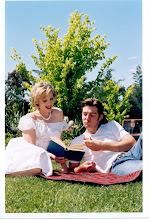
Recently I had the absaloute delight of visiting the bi-annual open garden at Cruden Farm, home to Dame Elisabeth Murdoch. It was a darling of a day - weather was late spring perfection, and I was dressed in my vintage 'garden party' floaty yellow roses dress ! The garden was beathtaking, as one would expect of a garden that has been the owners pride and joy since the 1920s!! But without a doubt, the highlight of my day was being able to speak to Dame Elisabeth, even if it was simply to tell her how much her garden inspired me ! I dont care if you are wealthy or middle class or poor, if you are 100 years old and opening your home and garden to what appeared to be THOUSANDS of visitors, if you are 100 years old and you are out and about mingling with all these strangers, greeting them, smiling, having your photograph taken with them, all with a gentle graciousness while they trample and smoke, drink and eat in your pride and joy, then you are a heroine in my books !!

Here are some photographs of the inspiring garden - please forgive the crowds, it was nigh on impossible to take a picture without someones head getting in the shot (if you dont like crowds I would sugest not going to this open garden).

But it is Dame Elisabeth I would like to give homage to, she has established her garden throughout most of the 20th Century, and therefore the life of this philinthropic woman and her garden are perfectly suited to a 20th Century vintage blog post !

Dame Elisabth was born on Feb 8, 1909 and is the widow of Ausralian newspaper publisher, Sir Keith Murdoch whom she married in 1928. Sir Keith and Dame Elisabeth had four children - Janet, Helen, Anne and Rupert. Dame Elisabeth found solice and enjoyment in her life at Cruden Farm, which was a very simple Langwarrin acerage when Keith first purchased it as a wedding presant. The couple employed the then up and coming Ausralian Landscape Designer, Edna Walling, to design a garden for the property. Dame Elisabeth has since heavily modified Walling's original design, making the garden uniquely her own.

Dame Elisabeth has involved herself in philinthropic pursuuits all her life long. Before her marriage, Dame Elisabeth worked for the RSPCA and joined the management committee of the Royal Children's Hospital in 1933, functioning as Presiden 1954 to 1965. Dame Elisabeth is a life-governor of the Royal Women's Hospital and is Patron of the Murdoch Children's Research Institute and of the Australian American Association (Victoria). She is also a patron and founding member of disability organisation EW Tipping Foundation, and a founding member of the Deafness Foundation of Victoria. The first woman on the council of trustees of the National Gallery of Victoria, Dame Elisabeth Murdoch was a founding member of the Victorian Tapestry Workshop. Phew !! I am exhausted just thinking about all those involvements !

An article in The Age 2003 stated that "Few can rival Dame Elisabeth's enormous contribution. Her interests are so many they need to be alphabetically catalogued: academia, the arts, children, flora and fauna, heritage, medical research, social welfare. Many of Melbourne and Australia's most cherished institutions, from the Royal Children's Hospital to the Australian Ballet and the Botanic Gardens, have benefited from her involvement. But Dame Elisabeth also devoted herself to less popular causes: prisoners, children in care, those battling mental illness and substance abuse."

What an amazing woman, using her position and money to bless society. I am inspired by her lovely garden, and inspired by her tireless activities for the good of the community. I wish there were more Dame Elisabeths in the world !

If you would like to know more about this lovely woman and her garden, I would suggest borrowing or buying the book "Garden of a lifetime - Dame Elisabeth Murdoch at Cruden Farm" it really is a marvelous read and full of inspiring garden and family pictures throughout the 20th Century. Beautiful!!


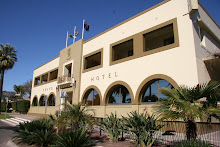
 Arnt these old Art Deco buildings just darling?! Thanks so much to my good friend Travis who shared these with me, they are from the beautiful town of Gundagi in central eastern New South Wales, Australia. I have said it before and I will say it again - you find such treasures in little old country towns ! This old town is now bypassed by the Hume Freeway, but once upon a time served as a rest stop on the journey from Sydney to Melbourne. Built on a foundation of agriculture, and then gold mining, Gundagi was made famous by the charming old song "Road to Gundagi" - first published in 1922. The song became particularly popular during World War 2. Brilliant Australian writer and poet, Banjo Patterson, also wrote a poem entitled "The Road to Gundagi" - so our humble little Art Deco town has graced quite a bit of Australia's 20th century history. Definatly worth a visit for history's sake !


 Well, you are sure to have seen his images gracing countless Coke Christmas advertisements at Christmas time over the years......let me tell you a little about this inspiring artist.........
 It was at this time that he turned to the 1822 poem "The night before Christmas' for inspiration for a Christmas advertisement, creating his interpretation of 'jolly old St Nick'. Sundblom based the rosey faced, beaming Santa on himself, and fitted his atire and merriment to the poetic description. For the next 33 years, he painted many many portraits of Santa that have etched themselves into popular culture.
 His many stunning vintage pin up images were used in advertising, calandars and Playboy magazine.
  Haddon passed away in 1976 leaving what would have to be the most recognisable image in all popular culture, Santa Claus himself